
Overview:
On Dec. 16, 1990, Haiti held its first peaceable democratic election, with Jean‑Bertrand Aristide successful 67% of the vote. It marked the start of a brand new chapter in Haitian political historical past, regardless of challenges that quickly adopted.
On Dec. 16, 1990, Haitians made historical past by holding the primary free and truthful presidential election within the nation’s trendy period, ushering in a wave of hope for democratic governance. The election drew large turnout and ended with a landslide victory for Roman Catholic priest Jean‑Bertrand Aristide, who gained roughly 67 % of the vote amid worldwide supervision and widespread jubilation.
Haiti’s journey to this landmark second was lengthy. After the brutal Duvalier dictatorships — first underneath François “Papa Doc” Duvalier after which his son Jean‑Claude “Child Doc” — collapsed within the mid‑Eighties, the nation endured a collection of provisional governments and disrupted election makes an attempt. An early effort in 1987 was derailed by bloodbath and army interference, underscoring the fragility of Haiti’s democratic aspirations.
Towards that backdrop, the 1990 election represented an unprecedented opening for Haitians to decide on their chief peacefully. Roughly 70 % of registered voters solid ballots. Worldwide observers on the time in Haiti included the United Nations Observer Group for the Verification of Elections in Haiti and the Group of American States.
Aristide — a priest identified for his advocacy on behalf of the poor and his critique of entrenched elites — emerged because the clear favourite. Working because the candidate of the Nationwide Entrance for Change and Democracy, he captured a powerful majority of votes solid, defeating a crowded discipline and securing a mandate to pursue reforms.
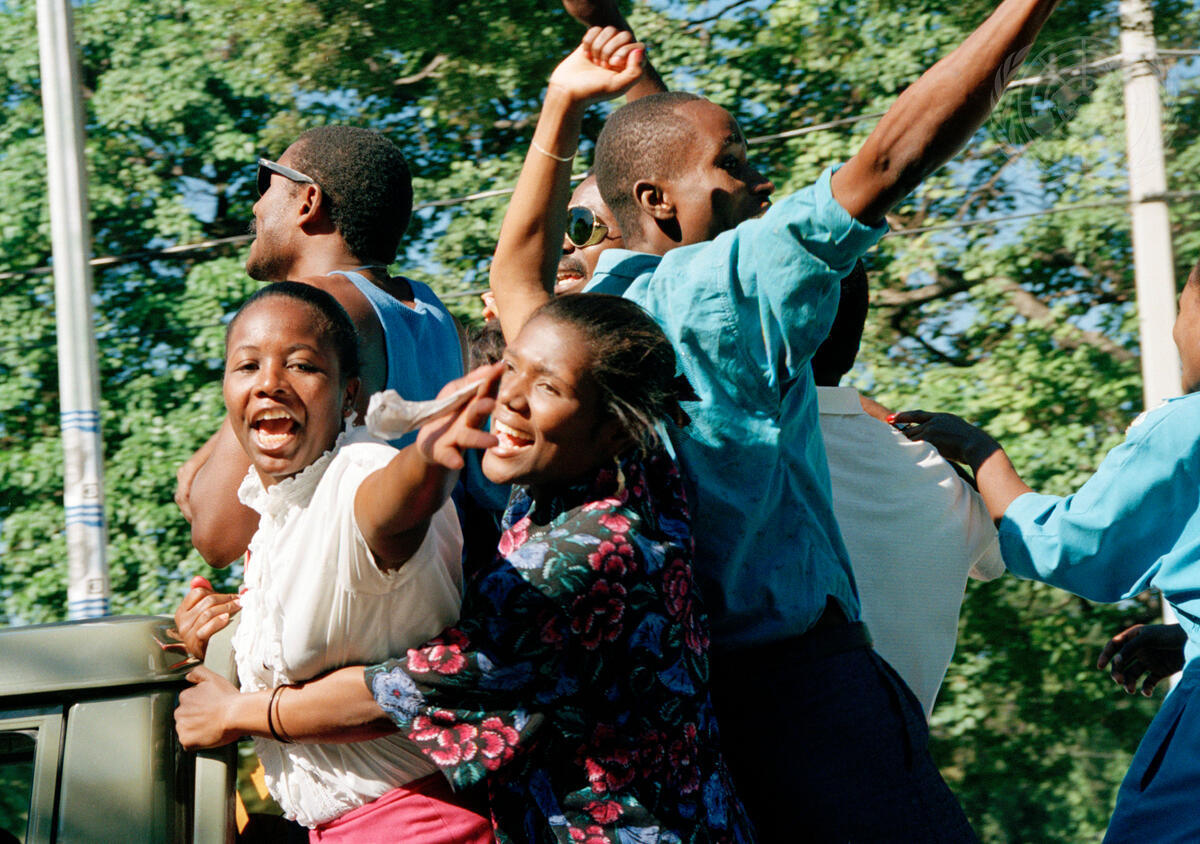
The peaceable end result of the electoral course of stirred celebrations throughout the nation, with Haitians taking to the streets in cities and cities to mark a turning level for his or her nation. For a lot of, it was not only a political victory however an emblem of resilience and dedication to construct a society ruled by alternative moderately than coercion.
Aristide was inaugurated on Feb. 7, 1991, however his tenure was quickly challenged by entrenched energy constructions against reform. Simply eight months later, on Sept. 30, 1991, he was violently overthrown in a army coup led by Gen. Raoul Cédras, who seized energy after troopers stormed the Nationwide Palace. The coup marked a return to authoritarian rule, triggering three years of political violence that killed an estimated 3,000 to five,000 individuals and compelled 1000’s into hiding.
Sept. 30, 1991 — The overthrow of Haiti’s first democratically elected president triggered a refugee disaster and formed U.S. coverage.
The unrest additionally unleashed one in every of Haiti’s largest migration waves, as tens of 1000’s fled the nation by boat looking for asylum in the US. Many had been intercepted at sea or detained at Guantánamo Bay, prompting criticism of discriminatory U.S. immigration insurance policies. Although Aristide was restored to energy in 1994 with the backing of a U.S.-led intervention, his return got here with financial circumstances that deepened inequality and weakened state establishments.
Nonetheless, the 1990 election endures as a defining second in Haitian historical past — the primary time the nation’s individuals freely selected their president, setting a precedent for democratic participation even amid repeated setbacks. Its legacy continues to reverberate by means of Haiti’s political evolution and throughout diaspora communities formed by the battle for democracy.